Ryden MTB Direct-Mount Chainring – CNC 7075 Narrow-Wide 1× Chainring
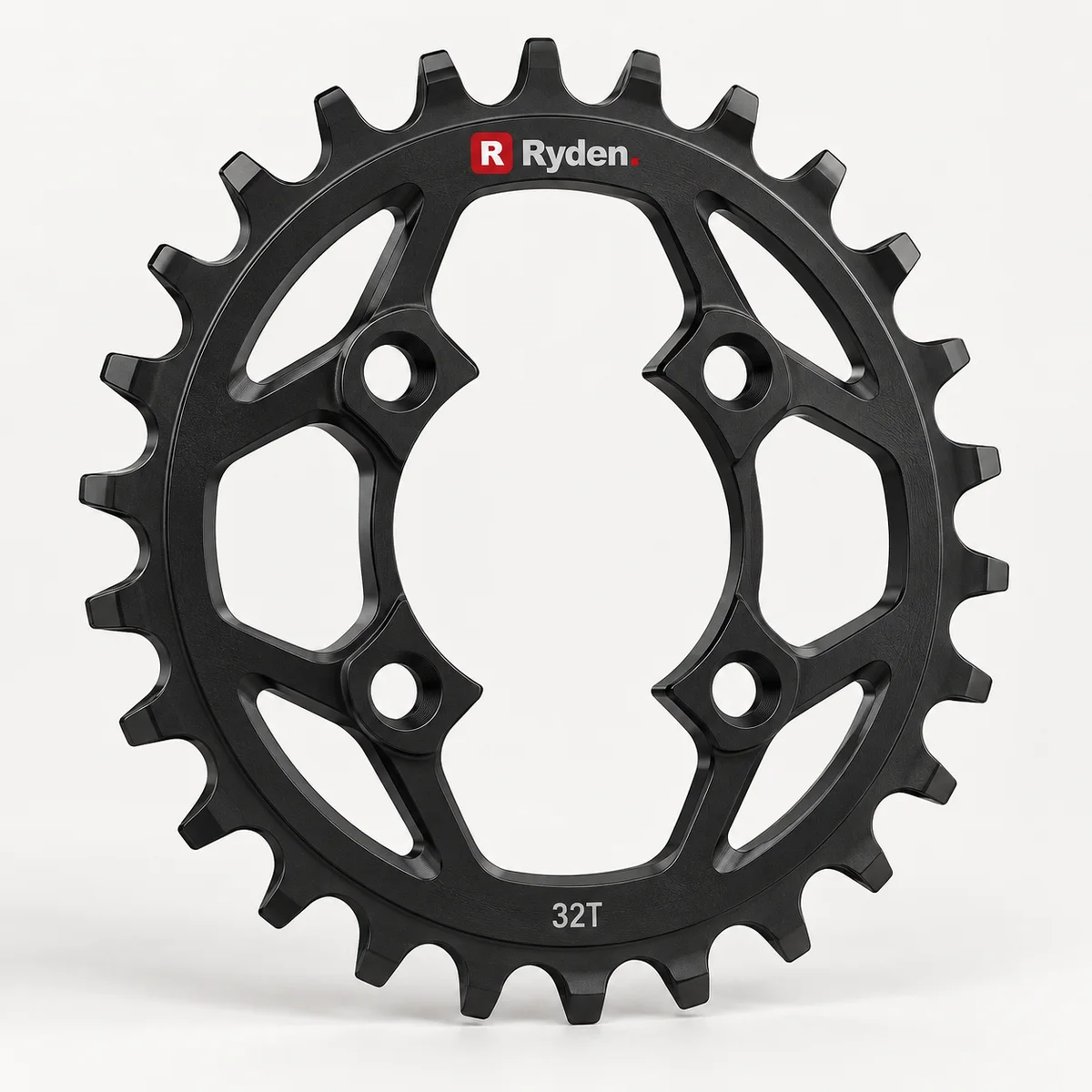
The Ryden MTB Direct-Mount Chainring is a lightweight, high-strength 1× mountain-bike chainring engineered for modern direct-mount cranksets. CNC-machined from 7075-T6 aluminum, it combines Ryden ChainLock NW II narrow-wide tooth profiling, an integrated direct-mount interface, mud-release channels, and MTB-specific chainline options for dependable chain retention across XC, trail, all-mountain, enduro, and bikepacking applications. By eliminating the traditional chainring spider and bolt hardware, the direct-mount design reduces weight, improves drivetrain integration, and allows different offsets for standard, Boost, and selected Super Boost chainlines.
Direct-mount interfaces differ between crank manufacturers: confirm your crankset with us before ordering.
Standard for non-Boost frames, Boost for 148 mm rear hubs, Super Boost for selected 157 mm systems.
Some 12-speed chains use proprietary shapes: check your drivetrain with us if you’re unsure.
- ✓ Dedicated 1× MTB ring for direct-mount cranksets
- ✓ 28T to 38T
- ✓ 3-bolt, 8-bolt and Shimano-style interfaces
- ✓ Standard, Boost and Super Boost offsets
- ✓ Ryden ChainLock NW II narrow-wide teeth
- ✓ 10, 11 and 12-speed versions
Direct connection. Precise chainline. Trail-ready retention.
Eliminates the conventional chainring spider and chainring bolts for a cleaner, lighter, and more integrated crank-to-chainring connection.
An advanced narrow-wide tooth pattern improves chain engagement and retention across rough MTB terrain.
High-strength aluminum keeps weight low while maintaining the stiffness required for modern 1× mountain-bike drivetrains.
Different offset versions help maintain correct chainline across modern MTB frame and rear-hub standards.
Open machining and deep tooth-root clearance help reduce mud accumulation around the chainring.
Modern mountain-bike drivetrains have increasingly moved away from traditional chainring spiders and bolt circles. Instead, many cranksets mount the chainring directly onto the crank, and the Ryden MTB Direct-Mount Chainring is designed specifically around this modern architecture.
Removing the separate spider and chainring bolts means less hardware, lower weight, a cleaner appearance, greater offset flexibility, and easier 1× integration. The chainring is CNC-machined from 7075-T6 aluminum, providing an excellent strength-to-weight ratio for XC, trail, enduro, and all-mountain riding.
At the teeth, Ryden’s ChainLock NW II architecture uses alternating narrow and wide profiles corresponding to the inner and outer links of a bicycle chain. This tighter engagement helps control lateral chain movement over roots, rocks, drops, rough descents, high-speed trail chatter, and technical climbs, and works particularly well alongside a clutch-equipped rear derailleur.
A direct-mount design also gives much greater control over chainring offset: separate versions position the ring correctly for traditional, Boost, and wider MTB chainlines. That matters because modern drivetrains depend heavily on proper chain alignment between the front chainring and the middle of the cassette; incorrect chainline can negatively affect shifting, noise, wear, and chain retention.
The Ryden MTB Direct-Mount Chainring is therefore not simply a lighter version of the standard Ryden Narrow-Wide Chainring. It is the more integrated, MTB-specific option for modern cranksets: direct connection, precise chainline, and trail-ready retention.
Ryden ChainLock NW II
A more advanced version of the narrow-wide profile used on the standard chainring:
- Alternating narrow/wide teeth
- Matches the alternating internal spaces of the bicycle chain.
- Extended engagement profile
- Slightly taller tooth engagement helps maintain contact over rough terrain.
- Leading-edge chamfers
- Help guide the chain onto the ring smoothly as it articulates.
- Rear relief profiles
- Reduce unnecessary friction as chain angles change across the cassette.
- Mud-release tooth roots
- Deep valleys give mud and debris more space to escape.
- Rounded transition surfaces
- Help avoid unnecessarily sharp contact points that could increase chain wear.
Why direct mount?
- Lower system weight
- The crank does not need a conventional multi-arm spider and separate chainring bolts.
- Cleaner appearance
- The chainring integrates directly into the crank interface.
- Better offset control
- The chainring itself incorporates the required offset.
- Easier gearing changes
- On compatible cranksets, you can replace the complete ring without managing multiple chainring bolts.
- Smaller chainrings
- Direct-mount architecture can make very small chainring sizes easier to package than some traditional BCD systems, which is particularly useful for 28T and 30T MTB gearing.
Questions about this product (15)
A (Ryden team): It is designed for modern 1× mountain-bike drivetrains using compatible direct-mount cranksets.
What is the standard tooth count?+
32T.
What sizes are available?+
28T, 30T, 32T, 34T, 36T, and 38T.
Which size should most trail riders choose?+
32T is the best general starting point.
What is the benefit of direct mount?+
It eliminates the traditional spider/chainring-bolt arrangement, reducing hardware and allowing better control of chainring offset and chainline.
Is it narrow-wide?+
Yes. It uses Ryden ChainLock NW II narrow-wide tooth profiling.
Does it work with a front derailleur?+
No. It is designed for dedicated 1× drivetrains.
Is it available for Boost bikes?+
Yes. Choose the Boost offset version for your crank interface.
Can I use a standard-offset ring on a Boost bike?+
Not automatically. Correct offset depends on the crank, frame, rear hub, and desired chainline.
Does it fit every direct-mount crank?+
No. Direct-mount interfaces differ between crank manufacturers.
Can I use it with a 12-speed drivetrain?+
Yes, with the 12-speed version. Some 12-speed drivetrains use proprietary chain shapes, so check yours with us if you’re unsure.
Is a clutch derailleur required?+
Not strictly in every application, but it is strongly recommended for MTB use.
Can I use it on an e-MTB?+
Only where the interface and drivetrain are compatible and the load suits a lightweight aluminum ring. For high-torque mid-drive systems, the Ryden E-Bike Chainring is the better choice.
Do I need a new chain if I change chainring size?+
Not always, but chain length must be checked whenever the tooth count changes significantly.
Does direct mount improve performance?+
Its main advantages are lower component count, potential weight reduction, cleaner integration, and better chainline/offset flexibility. It does not automatically make a rider faster.
You might also like
Guides from our blogs
How to tell what speed your drivetrain is (in under a minute)
Count sprockets, read your shifter, double-check the chain: the three-step check that prevents most fit mistakes.
Read more →When to replace your chain, and what happens if you don’t
A worn chain wears your cassette and chainrings with it. Here’s how to measure it and when to act.
Read more →Secure checkout
Encrypted card & PayPal payment
30-day returns
On unused items in original packaging
Brand-authentic
Quality-tested and warrantied
Worldwide shipping
Tracked delivery to 100+ countries